
November 25, 2025 | Boston
Day and night, changing seasons— life evolved within these cycles of light. Recurring rhythms of light and darkness govern our bodies and minds, and disruptions to these rhythms can have profound effects on everything from global biodiversity to the way we dream. October 28, 2025, marked the U.S. premiere of Lighten Up! On Biology and Time, an exhibition exploring these intimate connections between light, life, and perception.
Originally organized and first presented by EPFL Pavilions in Lausanne and later exhibited at the Gewerbemuseum Winterthur, the exhibition opened its doors last month at the MIT Museum in Cambridge, MA, inviting visitors to explore different ways of experiencing the rhythms that govern life. To celebrate the premiere of the exhibition, Swissnex and the MIT Museum organized an interdisciplinary symposium on October 29—a day of enlightening conversations that invited artists, scientists, and members of the broader public to discover the exhibition’s themes through a range of artistic and scientific perspectives.

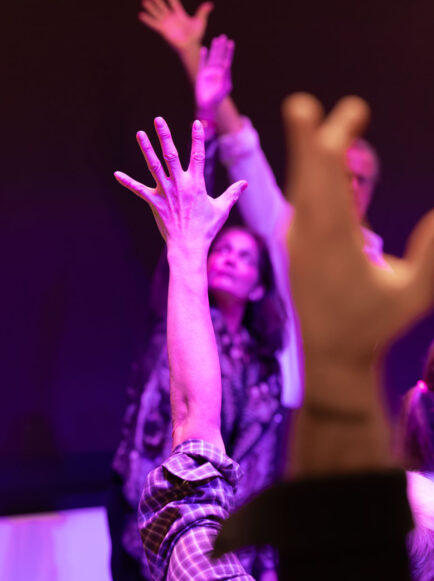
Moderated by Lee Moreau, the program unfolded according to spectrum of visible light—indigo-blue-green-yellow-orange-red—reflecting the symposium’s prismatic approach to its subject. Transitions in the program were accompanied by shifts in the room lighting, subtly refracting each thematic segment into a different hue.
The day began with a movement session led by dance advocate and Harvard visiting artist Ana Harmon, followed by a discussion of circadian rhythms by neuroscientist Elizabeth Klerman of Harvard University and biologist Guy Amichay of Northwestern University. Exploring the many clocks that structure life, from the synchrony of fireflies to the circadian, lunar, and seasonal rhythms that govern both ecosystems and human bodies, Klerman and Amichay illustrated how temporal patterns shape lives, human and beyond.

The program then turned to the exhibition itself. Marilyne Andersen, Professor at EPFL and co-curator of Lighten Up!, led participants on a guided tour of the exhibition. Andersen discussed the project’s origins at EPFL, where her research in daylighting and chronobiology gradually grew into a collaboration with artists, designers, and engineers, and explored how the featured works translate biological timing into space, color, and motion. Among the works is one of her own, Circa Diem 2, which immerses viewers “into a dim, oppressive abstraction of a dense city in which one slowly experiences four phases of the day while following a sunpath, enriched by the magical yet ephemeral appearance of refraction-generated imagery.”
In the afternoon, the conversation turned to the ecological consequences of light, with a presentation by biologist Avalon Owens, a Research Fellow at the Rowland Institute at Harvard. Owens described how light pollution is driving global insect decline, disrupting many crucial behaviours across a range of species. She emphasized that unlike other environmental stressors, light pollution can be addressed with simple design changes—proper use of directional shielding, timers, and motion sensors can dramatically reduce the effects of light pollution without affecting the usefulness of outdoor lighting.
The symposium concluded with conversation on sleep, darkness, and the emerging field of dream engineering. Seth Riskin of the MIT Museum Studio and Adam Haar Horowitz of Dust Systems, who collaborated on a new work for the U.S. exhibition, ranged across neuroscience, personal reflection, and speculative futures, inviting listeners to consider dreaming as a perceptual state in its own right. “Sleep has always been imagined as private, but brain science is showing us otherwise,” said Horowitz. “We don't dream alone. Light, sound, the smallest motions of the others around us — they all come with us into sleep.”
Following the symposium, the conversation continued at the Swissnex office, where Andersen joined in a public conversation with Geneva-based artist Alan Bogana, her long-time collaborator at EPFL, whose work is also featured in the exhibition. The two explored how they use light to shape both matter and meaning, Bogana through “solidifications of light”—sculptures made by propagating light through photosensitive resin—and Andersen through her work in daylighting, an architectural approach that optimizes for natural light. Sharing visual excerpts, stories from the laboratory, and insights from the development of the Lighten Up!, the two traced the porous boundary between scientific inquiry and artistic practice.

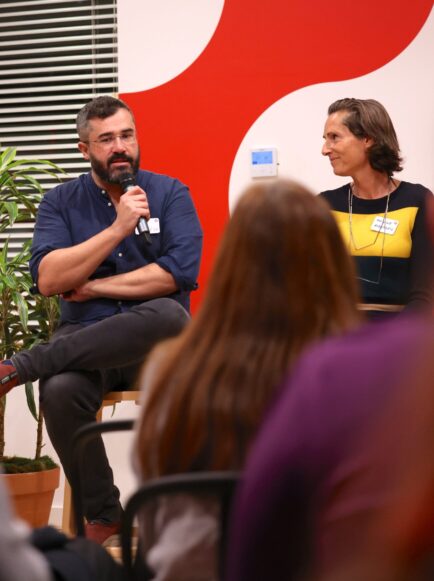
“The exchange really underscored what the symposium made clear,” said Zohra Briki, Academia & Arts Program Manager at Swissnex and moderator of the evening event. “That when rigor and creativity meet, light becomes not just a physical phenomenon, but a way of thinking, sensing, and understanding the world.”
Lighten Up! On Biology and Time is on exhibit at the MIT Museum until August 2026.


