

Chandni Doulatramani
Communications Manager
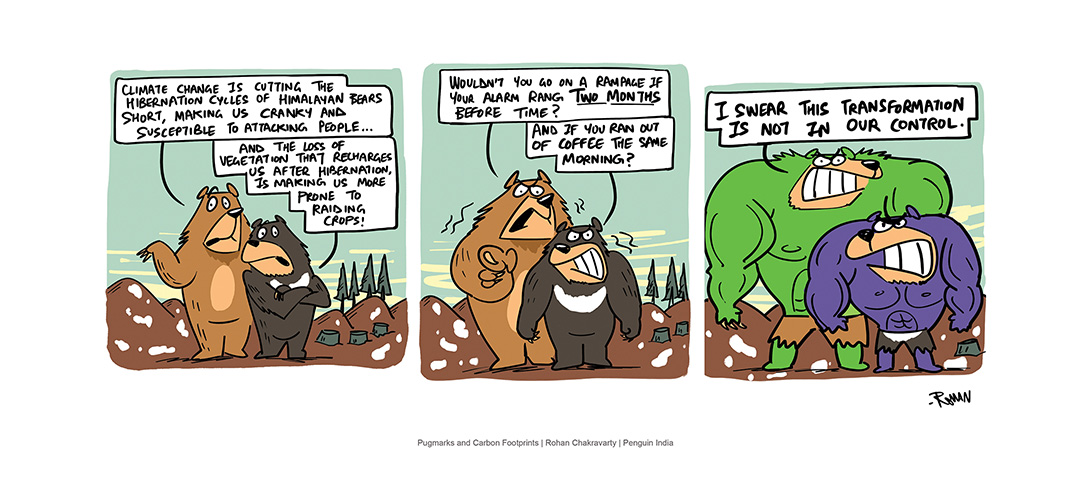
Bengaluru, September 21, 2026: Think of a three-panel cartoon. In the first one, a bear is fast asleep in its den, and outside the Himalayan glaciers are melting at breakneck speed. In the next, the bear is suddenly awake because climate change has interrupted its hibernation. To help readers understand what that feels like, Indian cartoonist Rohan Chakravarty uses a common human experience: imagine how annoyed you’d be if your alarm clock went off ten minutes before it was supposed to. For the bear, it’s a whole two months. The melting glaciers are the bear’s alarm clock.
Just as a sleep-deprived human’s system would go out of whack, a bear’s system would similarly malfunction, making it aggressive. In the final panel of the cartoon, the bear turns into a rage-fuelled Hulk. Rising temperatures have been disrupting the hibernation cycles of Himalayan bears, and therefore human-wildlife encounters are becoming more common.
For decades, climate communication has operated on the belief that if people understand the science, they will do something about it. Yet despite an overwhelming body of evidence, climate change often remains abstract, overwhelming or just too complex to hold our attention for long. Facts, it turns out, are rarely enough.
In June, we invited Rohan for a closed-door session where he gave us a glimpse into the mechanics behind his environmental cartoons. Rohan runs Green Humour, a series of cartoons, comics and illustrations on wild animals; wildlife and nature conservation, environment, sustainability and all things green, and is one of the largest collections of cartoons on wildlife and environment on the web.
Before Rohan puts pen to paper, there is a process. A research paper on disrupted hibernation is not immediately funny, nor is it immediately visual. Rohan’s first task is to distill the complex scientific concept into a handful of ideas that are easily recogniseable. So climate change becomes melting glaciers. Interrupted hibernation becomes the alarm clock going off too early. The anger that results from it takes the form of the Hulk, a universally recognised representation of aggression.
Science communication is often mistaken for making research easier. The real challenge, however, is in making it relatable without compromising on scientific accuracy. Rohan admitted that he often tones down a joke if it risks distorting the science. Every cartoon begins with research, followed by careful visual decisions and only then does the punchline emerge. Even the silliest gag is rooted in careful observation of animal behaviour and ecological research.
During the session, Rohan described humour as a handshake between the subject and the audience.
Climate change, biodiversity loss and ecological collapse are emotionally exhausting topics. They are often communicated through statistics, warnings and catastrophic images, all of which are necessary but aren’t always the best at inviting people into the conversation. Humour makes it easier and lowers the barriers to engagement. It replaces intimidation with curiosity, creating space for audiences to pause, laugh and maybe even keep reading.
By using humour, the issue doesn’t become less serious. Humour is effective because people are more likely to remember things if they are surprised by it or delighted by it or feel something because of it.
Different kinds of humour evoke different emotions. Rohan uses a multitude of genres and forms in his work. Some rely on satire, others on visual absurdity or (pop) cultural references. Sometimes there’s a joke within a joke that not everybody gets and that creates a different kind of connection between the audiences and the artist. Like a secret club, if you will (were you also part of the club that recognised Hulk’s purple parody Infraggable Krunk from The Dexter’s Laboratory?).
As the world increasingly grapples with complex issues, from climate change to artificial intelligence, how we communicate science has become as important as the science itself.
Humour reminds us that communication is, after all, about connection. A well-crafted joke can make an unfamiliar scientific concept feel familiar. It can transform passive audiences into active participants and create entry points into subjects that might otherwise feel intimidating or inaccessible.
Swissnex has long explored creative ways to bridge research and society, bringing together scientists and artists, entrepreneurs and policy makers to spark new conversations. At Swissnex in India, we have experimented with this approach through campaigns like #PlanetRoast, a social media challenge that invited people to “roast” the planet and scientists responded with evidence-based explanations. Increasingly, these conversations recognise that science communication and public engagement is more than just about broadcasting information. It’s also about creating experiences that invite participation.
In an age where we’re bombarded with information and our attention spans are shrinking, one of science communication’s greatest challenges is making science resonate with audiences. A cartoon will not solve the climate crisis, but it may get more people to stop scrolling, think about what they’re looking at and start asking the right questions.
Chandni Doulatramani