

Chandni Doulatramani
Communications Manager
Zurich, September 5: If you walk through Zurich’s former industrial belts and transit corridors, you’ll see that the palette is almost entirely concrete. And under an overcast sky, the city turns into its own version of fifty shades of grey, a dull continuum of building facades, paved roads, sidewalks, utility poles and sprawling electric grids.
For decades, modern urban planning has focussed on paving sidewalks, asphalting parking lots and channelling every drop of rain straight into the drains and out of the city. But with intensifying heatwaves, like the several Europe saw in June and July this year, it is precisely the concrete that is transforming neighbourhoods into heat-trapping ovens.
After years of concretising the city, Zurich is now trying to break its shell. Die Asphaltknackerinnen or “the asphalt crackers” is an environmental initiative of Plan Biodivers, an eco agency specialising in biodiversity consulting, environmental communication and urban nature restoration. Die Asphaltknackerinnen is dedicated to unsealing the ground on private properties, letting the soil breathe and transforming Zurich into a “sponge city”. What this means is that the ground is treated like a giant natural filter rather than a waterproof funnel.
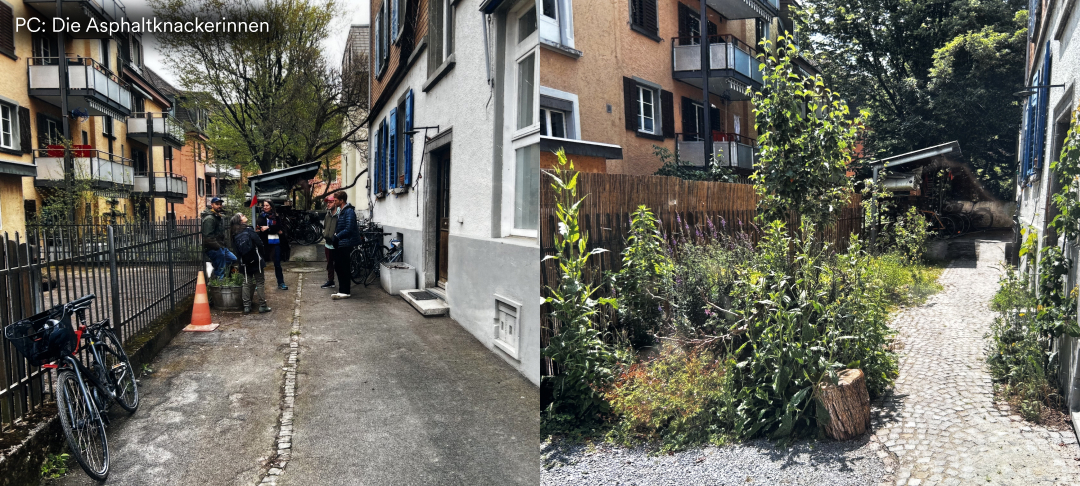
When a city is covered in asphalt, rain cannot infiltrate the earth and sit in the soil. The ground loses its natural capacity to cool the surrounding air through evaporation during summer. Additionally, all that water with nowhere to go ends up in sewer systems, which can cause sudden flash floods in the city.
By cracking open the concrete, Asphaltknackerinnen’s goal is to maximise underground water retention allowing soil to hold on to excess water during heavy rainfall and slowly release it back into the atmosphere through plants and trees as the weather becomes warm. Replacing the concrete with gravel, plants and trees is a common method used to do this in areas such as parking lots, apartment complex courtyards, pavements, public squares, private driveways, garages and front yards.
Because many parts of Swiss cities belong to private landowners, local governments cannot simply roll in with excavators. So public authorities use Asphaltknackerinnen to promote and implement public climate goals on private land.
How it works is that a homeowner, housing cooperative or a business reaches out to Asphaltknackerinnen for a free on-site evaluation, where they inspect the area to make sure the asphalt can be removed without damaging underground utilities and can be replaced with gravel or flower beds.
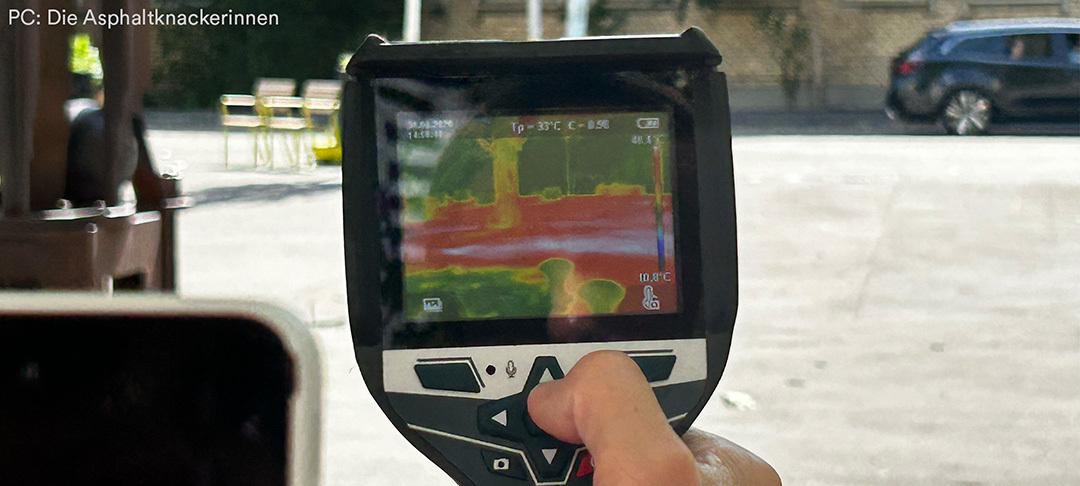
Biologist, former journalist and Die Asphaltknackerinnen co-founder Isabella Sedivy rarely goes anywhere without her thermal camera. By measuring surface temperatures around the city, she captures the stark reality of the heat island effect: on a 23°C sunny day, concrete bakes at 52°C, whereas grass sits comfortably at just 25°C.
What Die Asphaltknackerinnen does on a small scale, the city of Zurich is starting to apply on a large scale: parking spaces are being removed to make room for green public spaces featuring trees, benches and native perennials. The soil is also enriched with biochar, a special type of charcoal made specifically to improve soil health. Biochar is created by heating organic matter like wood waste and leaves at high temperatures with very little oxygen, and instead of burning into ash, the material turns into a stable, carbon-rich solid.
In some public spaces, where the heat is particularly intense, trees are temporarily placed in special “air pots” or containers designed with open-air holes that force roots to grow thick and healthy rather than getting root-bound. Equipped with soil sensors, these pots monitor the saplings’ condition, helping the team track when the young trees need water and how well they are handling the city heat before they are permanently planted elsewhere.
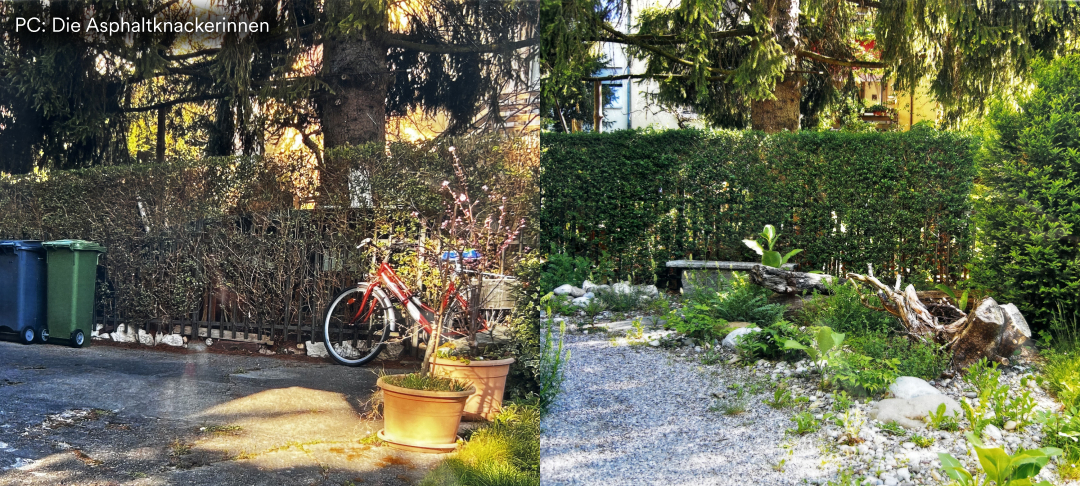
Breaking asphalt, however, before any of the resurfacing happens, is labour intensive and expensive. And it is also costlier to constantly maintain gravel and grass compared with asphalt. But the environmental returns and benefits for planetary health, including human health, far outweigh the financial cost over time, which is why it has drawn major backing from the Mobiliar Cooperative, one of Switzerland’s major insurance cooperatives.
Funding this project is in Mobiliar’s best interest because as an insurer, when extreme heat damages infrastructure or a flash storm floods hundreds of basements in Zurich, they are the ones who have to pay millions of Swiss Francs in claims to fix the damage.
There is also a stark contrast in governance. Zurich treats its urban canopy as protected civic infrastructure, where cutting down a mature tree triggers heavy financial penalties and strict, legally binding obligations to replace the lost biomass. In rapidly urbanising centres across India and Uganda, tree-cutting regulations often exist on paper but fall short in practice, allowing developers to clear mature cooling canopies for quick construction.
The lesson from Die Asphaltknackerinnen is that cities in the Global South must stop sealing their remaining ground before it’s too late. The Global South has a brief window to leapfrog the concrete era. Just as many African countries skipped landline telecommunications to go straight to mobile networks, expanding cities in India and East Africa can skip the 20th century obsession with paving over every square metre of earth. Preserving existing natural sponges today costs a fraction of what cities and private owners are paying to break concrete open tomorrow.
Chandni Doulatramani